
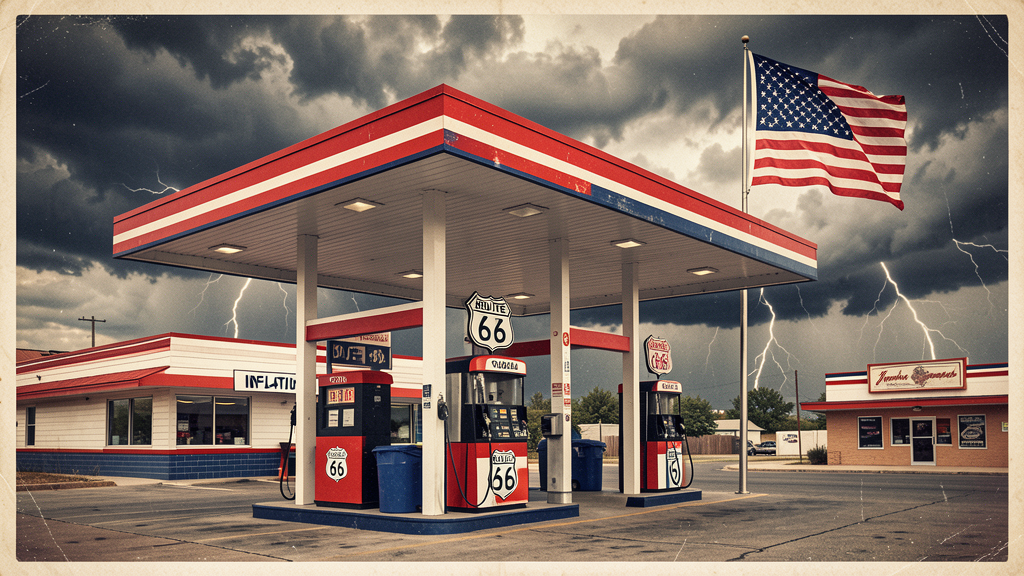
June 10, 2026 — the day inflation crossed the 4% threshold for the first time in over three years. And it wasn’t even a surprise. The May CPI report landed exactly where economists expected: headline up 4.2% year-over-year, core at 2.9%. The market’s response? A 1.6% drop on the S&P 500, a 1.9% slide on the Nasdaq, and Treasury yields that can’t seem to make up their mind.
But here’s what the headline misses: energy accounted for over 60% of the monthly increase. Gasoline prices are up 40.5% year-over-year. Strip out food and energy and you get a core monthly reading of 0.2% — below the 0.3% consensus. This is a supply-shock inflation story, not a demand-overheating one, and that distinction matters enormously for how you position a portfolio right now.
The Iran Premium Is Real
Let’s not dance around it: the U.S. is in an active military conflict with Iran. Tuesday evening brought “self-defense strikes” in response to Iran downing a U.S. Army Apache helicopter patrolling the Strait of Hormuz. On Truth Social Wednesday morning, President Trump warned Iran would “have to pay the price” and pledged “we’re going to be attacking them very hard.” Oil responded accordingly — WTI crude jumped to $91.80 a barrel, up over 4% on the day, while Brent touched $93.
The Strait of Hormuz handles roughly 20 million barrels per day of crude and petroleum products. Even partial disruption sends energy costs rippling through the global economy. This isn’t theoretical — it’s showing up in the CPI data in real time. Energy goods rose 3.9% month-over-month. Airline fares, a direct derivative of jet fuel costs, surged another 2.7% in May and are now up 26.7% year-over-year.
Real Wages Are Going Backward
Here’s the number that should worry every consumer-facing investor: real average hourly earnings fell 0.7% year-over-year in May. That’s the second straight monthly decline. Nominal wage gains can’t keep pace with a 4.2% inflation rate, which means households are getting poorer in purchasing-power terms. Heather Long, chief economist at Navy Federal Credit Union, captured it bluntly: “It’s not just bad vibes about the economy now, there are real financial pressures, especially on middle-class and lower-income households.”
The silver lining — and it’s thin — is that core CPI at 0.2% monthly suggests the inflation isn’t broadening. Core goods actually dipped 0.1%, and motor vehicle insurance posted its biggest drop since October 2020. The tariff pass-through that juiced goods prices in early 2026 appears to be fading. Shelter inflation, while still sticky, decelerated from 0.6% monthly in April to 0.3% in May.
The Fed Is Stuck — And Markets Are Pricing a Hike Anyway
The CME FedWatch Tool puts a 98% probability on the Fed holding rates at 3.50–3.75% at next week’s meeting. No surprise there. But here’s the twist: futures markets are pricing a 70% chance of at least one rate hike by December. The Fed’s easing bias is effectively dead. Economists now expect rates on hold into 2027, and BMO’s Scott Anderson warns that “if we don’t see a moderation in energy prices soon, it will only be a matter of time before we see more visible spillovers into inflation expectations.”
Treasury yields reflect this tension. The 10-year sits at roughly 4.52%, down slightly on the day as the core CPI miss gave bond traders something to cling to. But the curve is bear-flattening — short rates rising faster than long rates — which historically signals markets expect the Fed to over-tighten into a slowing economy. The 2-year/10-year spread is worth watching closely in the weeks ahead.
The Rotation Nobody’s Talking About
While the indexes fell, look beneath the surface. Nine of eleven S&P 500 sectors closed green on Tuesday. The sell-off is concentrated in tech — specifically semiconductors, where the SOXX index has shed over 10% from its all-time high. The working theory: the SpaceX IPO is vacuuming up capital that had been parked in chip stocks. Whether that’s true or just a convenient narrative, the rotation is real. Defensive names are hitting all-time highs: Coca-Cola, TJX, MetLife, Principal Financial, WW Grainger.
Energy stocks, predictably, are the other bright spot. Baker Hughes and Valero both gained over 1% on rising crude. Gold, meanwhile, dropped 2.5% to an 11-week low below $4,200 — the strong dollar ($DXY briefly above 100) is punishing the traditional inflation hedge, reminding investors that in a rate-hike environment, the dollar itself becomes the safe haven.
What to Watch Tomorrow
Thursday brings the May Producer Price Index. Consensus expects headline PPI at +0.7% month-over-month, down sharply from April’s +1.4%. Core PPI is forecast at +0.4% versus +1.0% in April. If those numbers hold, it suggests the energy shock hasn’t yet cascaded deeply into the production pipeline. An upside surprise, however, would validate the rate-hike trade and likely send equities lower.
The Investor Takeaway
This isn’t 2022. The inflation problem today is narrower — overwhelmingly an energy story with a geopolitical root cause. That means it’s potentially more acute (40% gasoline inflation is brutal) but also potentially more reversible than the broad-based demand inflation of three years ago. A ceasefire in the Gulf, a reopening of the Strait of Hormuz, and crude could fall faster than it rose.
Until then, the playbook is straightforward: energy exposure works, defensives with pricing power hold up, and high-multiple tech is vulnerable to both rate expectations and capital rotation. Keep an eye on core PCE estimates (tracking ~3.3% year-over-year based on today’s CPI data) and watch whether inflation expectations in next week’s University of Michigan survey start to break higher. That’s the signal that would change the Fed conversation from “on hold” to “hiking.”
One day’s CPI report doesn’t make a trend. But three consecutive hot prints plus an escalating Middle East conflict? That’s a pattern investors can’t afford to ignore.