
It’s summer and team members at the Econonaut decided to take some time off so we halted posting a articles but some of us are back and we come with some new observations and potential profit opportunities.
First, El Capitan spent the holidays in Europe and made some observations about Uber. The way the Uber business model is supposed to work is a customer taps the app and requests a ride share and usually within a few minutes or so a driver shows up and whisks you away to where you want to go. In theory, that’s the way the app, client and driver/provider is supposed to work but what I observed at airports and other areas where there are hoards of potential customers, Uber drivers would simply wait and solicit customers sans the Uber app.
I talked to a few Uber drivers and asked them why they were soliciting clients instead of just enabling the app and it turns out it is far more profitable for the driver to simply solicit a client in heavily populated “flash mob” customer areas like entertainment venues, airports or cruise terminals and offer rides directly. I observed this in action in Italy and other places and eventually took part because while I tried to use the Uber app all I kept getting was “No cars available” so if I wanted to get somewhere I had to partake in the Uber app boycott.
What does this mean for Uber? Ultimately, it means if mass amounts of drivers decided to opt out or boycott Uber and clients still need rides then they will just work something out with the drivers and avoid Uber app altogether.
Uber stock has been trending up on recent profitability but I don’t think this business model will work long term in its current model. The drivers I spoke to said Uber was taking too much money. On a $100 fair from an airport to city center, the drivers claimed Ubeer gets $60 to $80 and the driver gets the remaining fare. This seemed absurd so I did some checking.
I came across this article that states most Uber drivers make about $25/hour driving for Uber.
Let’s say a passenger takes a ride from Santa Monica, CA to LAX and the ride takes 30 minutes and comes out to 8.9 miles. In order to calculate your payout, we’ll need the current rates in Los Angeles, which are $0.28/minute and $0.80/mile.
Additionally, there’s a $4.14 marketplace fee (this amount is different for every city) the passenger pays that goes straight to Uber and estimated surcharges of $4.85. So the cost to the passenger looks like this:
- $6.50 minimum fare
- $8.40 = 30 mins. X $0.28/min
- $7.12 = 8.9 miles x $0.80/mile
- $4.85 = estimated surcharges
- $4.14 = Marketplace Fee
The total fare paid by the passenger for this ride will be $24.51. But the driver will receive a different amount. In order to calculate the driver’s cut, we need to subtract the marketplace fee ($4.14) and Uber’s commission (around 25%).
- $20.37 = $24.51 – $4.14 (Driver’s Gross Pay)
- $5.09 = 25% x $20.37 (Uber’s commission)
- $15.28 = $20.37 – $5.09 (Driver’s Net Pay for this ride)
As you can see, the Uber passenger paid $24.51 for this ride, but the driver ends up with a payout of $15.28 for about 30 minutes of work.
Source: TheRideShareGuy.com
After reading this article, it would seem to confirm that Uber’s share of the trip cost seems a bit high and the natural result is drivers opting to solicit clients in areas with heavy concentration of people such as concerts and airports.
So where are the profit opportunities? Well right now, some of us are looking at buying puts on Uber. The implied volatility is 37% for March 15 2024 $42.50 strikes and the premium is $3.35.
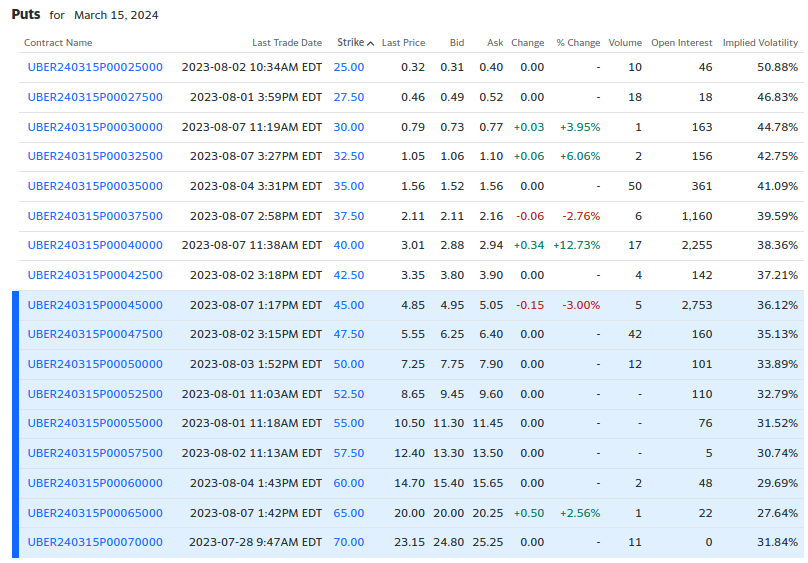
With the Fed poised to hike rates again at their next Fed meeting and seemingly intent on crashing the economy (and inflation), it would make sense that Uber may be approaching a peak. We’ll do more research and let you know if we decide to buy those puts but in the meantime stay tuned, stay profitable and stay solvent…