
Both CNBC and the Wall Street Journal have articles highlighting China’s demographic problem and what it means to the global community. From CNBC:
China is facing a demographic problem and needs to boost its productivity for growth, said David Mann, chief economist for Asia-Pacific, Middle East and Africa at the Mastercard Economics Institute.
“You need to see the productivity side pickup exactly because of the demographic challenge,” he told CNBC’s “Squawk Box Asia” on Monday.
“If you go back 10, 20 years in China, you had so much of growth coming purely from just more people showing up each year — that labor contribution rather than capital or productivity.”
Ironically, the United States is in the same boat with its own demographic crisis which can be easily seen on the graph below from the St. Louis Fed.
CNBC.com
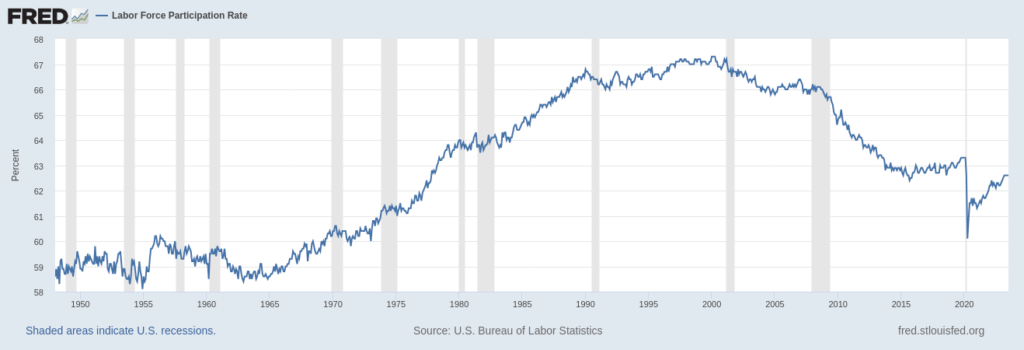
The Wall Street Journal reports that the era of cheap Asian labor is over with many companies in China and Vietnam struggling to find and retain workers even after offering perks found in high tech such as beer drinking, go-carts and bowling. Here is a quintessential quote from the article:
“There’s nowhere left on the planet that’s going to be able to give you what you want,” said Paul Norriss, the British co-founder of the Vietnam garment factory, UnAvailable, based in Ho Chi Minh City. “People are going to have to change their consumer habits, and so are brands.”
Wall Street Journal
Read that quote carefully and let it sink in, the era of cheap labor and cheap goods flowing from Asia onto the rest of the world are coming to an end. It’s not just Asia that has a demographic problem, it is in Europe and the Americas as well. The best way to find where the young workers are is to look at the global population and sort by median age. The chart below is from Wikipedia via CIA world fact book.

Most of the “young” labor in Africa, Middle East and parts of South America so if companies want to utilize labor in these countries they will need to build infrastructure to move goods and services from these locations and let the existing networks to other places deteriorate over time.
For a prudent investor, taking a look at these countries and the businesses that operate there for future profits is currently what we’re doing so stay tuned, stay profitable and stay solvent…