
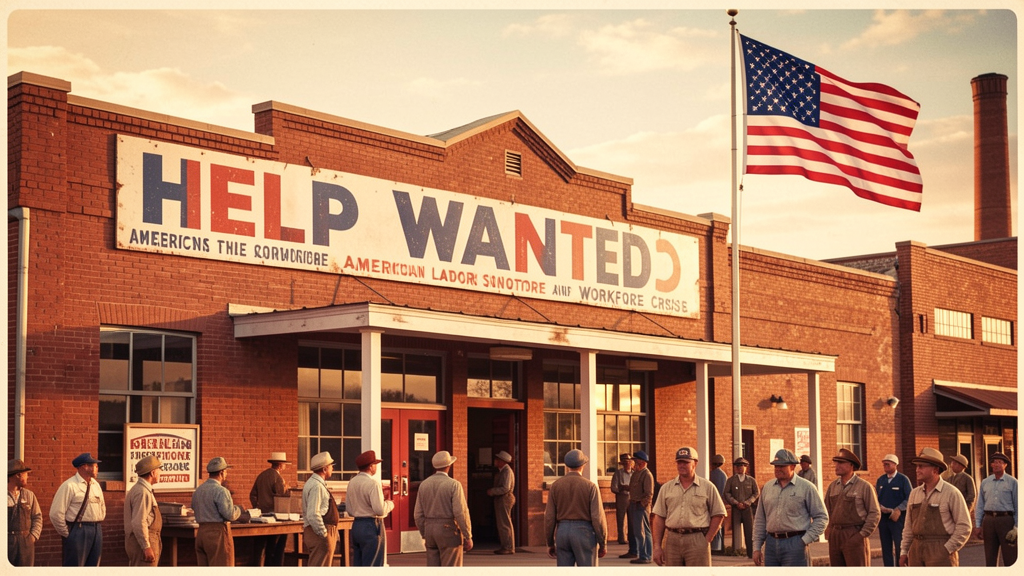
America doesn’t have a labor shortage — it has dozens of them, each with its own geography, industry, and root cause. Construction firms need 349,000 new workers this year just to break even on demand. Florida alone has 427,000 open jobs. Manufacturing could be short 1.5 to 2 million workers by 2030. And underneath all of it: the working-age population is barely growing, immigration has turned net-negative for the first time in half a century, and 26% of manufacturing workers are already over 55.
This week’s labor data paints a picture that’s equal parts resilient and unsustainable. The economy added 172,000 jobs in May, unemployment held at 4.3% for the third straight month, and job openings posted their biggest monthly surge in five years. But actual hiring remains stubbornly low and the Conference Board warns the U.S. needs 4.6 million new workers annually through 2033 to avoid a full-blown crisis. Last year? We added 1.1 million.
State By State: Where the Shortage Bites Hardest
Florida — 427,000 job openings as of December 2025, with unemployment at 4.7%. Construction, healthcare, and hospitality are the three hardest-hit industries. The Orlando metro area added 12,400 jobs in March alone — but employers can’t fill the skilled trades. “We’re trying to hire, and there’s not enough people to fill the qualified positions that we have,” said Michael Waldrop of Blue Cord Design & Construction in Orlando. The state’s demographic reality compounds the problem: 1 in 3 Central Floridians is 55 or older, meaning the talent pool is aging out faster than young workers are entering.
Virginia — The state tops the manufacturing hiring pressure index, with the highest ratio of job postings to existing manufacturing workers in the country. Defense contracting, advanced materials, and federal supply chains drive demand for machinists and maintenance technicians that simply aren’t available.
Texas — A 70,000-worker construction shortfall is affecting 20% of active projects. The state’s semiconductor fabrication megaprojects and data center buildout are pulling electricians — roughly 20% of whom are over 55 nationally — into a bidding war that smaller contractors can’t win.
North Carolina and Florida — The Associated General Contractors reports these two states had the highest rates of workers leaving mid-project or failing to show up (42% and 31% of firms reporting, respectively).
Montana, Vermont, New Hampshire — Smaller manufacturing states with aging workforces and limited training infrastructure face some of the highest per-capita hiring pressure, concentrated in food processing, wood products, and niche industrial work.
The Industry Breakdown
- Construction: 349,000 new workers needed in 2026, rising to 456,000 in 2027. Retirements — not new demand — drive the majority of the shortfall. Electricians are the choke point, especially in regions with data center and semiconductor booms.
- Manufacturing: 26% of the workforce is 55+. The sector faces 1.5–2 million unfilled roles by the early 2030s. Hiring pressure is most acute in smaller, specialized states rather than traditional industrial hubs.
- Healthcare: National nursing shortage rate of 8%. Florida hospitals are competing for the same talent pool as construction firms and hotels. One Chicago hospital was 20 nurses short while a trained Tunisian nurse was driving Uber in the same city.
- Agriculture: 68% of farmworkers are foreign-born; 42% of those are unauthorized. The Labor Department has acknowledged that unemployed Americans “will not make themselves available in sufficient numbers, even at current wage levels” to fill farm labor gaps. Food prices are projected to rise 14.5% from 2024 to 2028 as a direct result.
- Hospitality: Added 70,000 jobs in May — the single biggest sector gain — but Florida hotels and restaurants still operate below capacity due to staffing shortages.
The Immigration Factor
You can’t talk about labor shortages in 2026 without talking about immigration. For the first time in at least 50 years, the U.S. recorded negative net migration in 2025, with Brookings Institution estimating a net outflow of up to 295,000 people. Immigration has accounted for nearly half of U.S. labor force growth since 1995 — and virtually all of it in recent years, since the native-born working-age population is effectively flat.
The National Foundation for American Policy projects current immigration policies will reduce cumulative GDP by $1.9 trillion from 2025 to 2028 and $12.1 trillion by 2035 — roughly $34,000 per American. That’s not a labor statistic. That’s a growth crisis wearing a workforce shortage mask.
The Hiring Disconnect
Here’s the paradox at the heart of this labor market: job openings surged in April at the fastest rate in five years, but actual hiring remains near cyclical lows. Employers are posting positions aggressively while being extremely selective about who they bring on. The result is a market where millions of jobs exist on paper but the matchmaking between skills, geography, and employer expectations keeps breaking down.
Career and technical education is emerging as one bridge. Florida’s Orange Technical College serves 3,000–4,000 students annually, with construction certificates costing $3,000–$5,000 — a fraction of a four-year degree. “That pendulum has swung the other way,” said Senior Director Scott Weidl. “Career training is for everybody.” But scaling CTE fast enough to close a 349,000-worker construction gap is like filling a swimming pool with a garden hose.
What to Watch
- The Dignity Act of 2025 — a bipartisan immigration bill with 35 sponsors. If it gains traction, it could reshape the foreign-worker pipeline for construction, agriculture, and healthcare.
- Q2 earnings calls — listen for labor cost commentary from homebuilders, manufacturers, and hospital chains. Margins are where the shortage shows up first.
- Summer seasonal hiring — hospitality and construction both peak in summer. If May’s 70K leisure/hospitality gains can’t be sustained, expect restaurants and hotels to start cutting hours.
- Fed reaction — with inflation ticking up to 3.8% and the labor market tight, the Fed has zero room to cut. A worker shortage that drives wage inflation while restricting output is the hardest kind for monetary policy to address.
Sources: Bureau of Labor Statistics (May 2026 Employment Situation), Associated Builders and Contractors (2026 Workforce Shortage Model), Conference Board/CED (Responding to US Labor Shortages), MIE Solutions (Manufacturing Labor Shortages 2026), Spectrum News 13 (Florida Labor Shortage, May 25 2026), Brookings Institution, National Foundation for American Policy, Forbes, Fortune.