
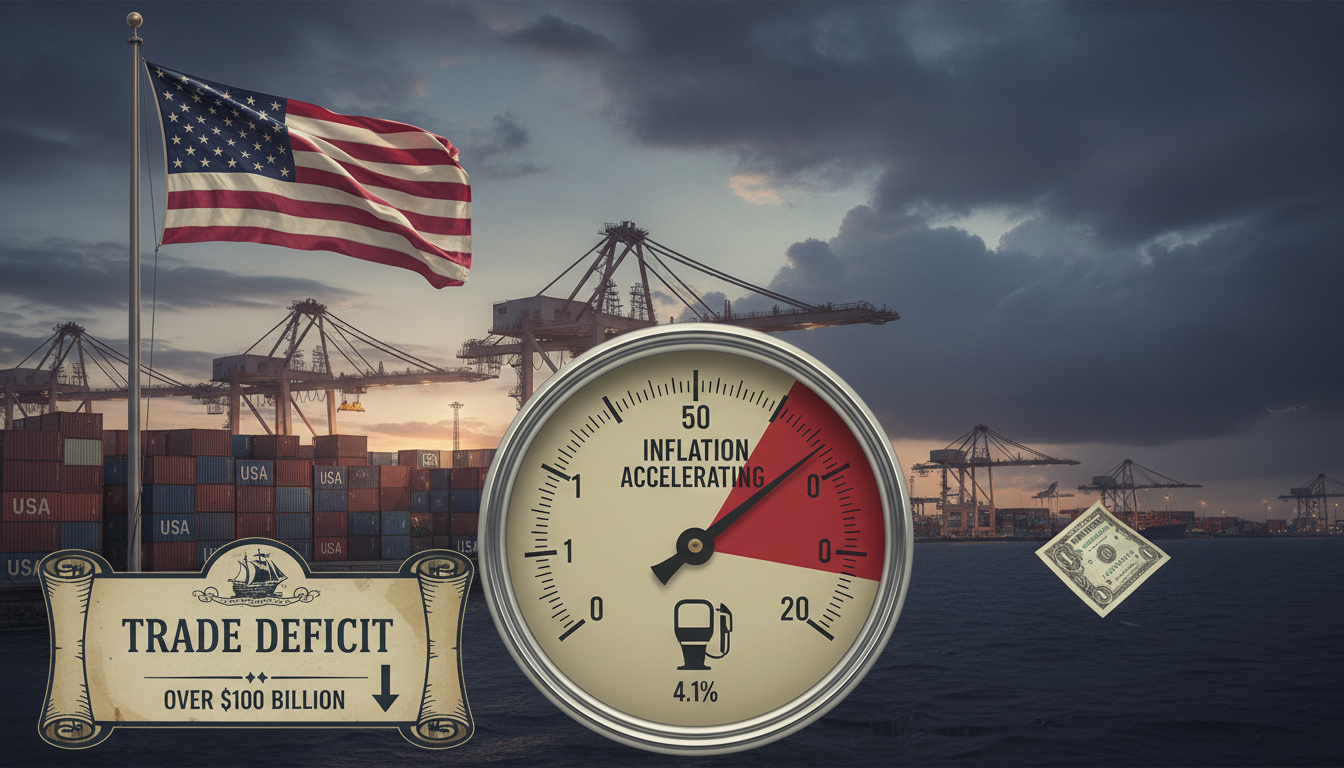
Thursday’s economic data dump was a Rorschach test for markets. Inflation hawks saw reacceleration — headline PCE climbing to 4.1% year-over-year. Growth bulls saw a consumer that refuses to quit — personal income and spending both jumped 0.7% in May. And GDP got a surprise upgrade. By Friday morning, the advanced trade data landed like a brick: the goods deficit blew past $100 billion for the first time since the pandemic supply-chain scramble. Here’s how the pieces fit together.
The inflation picture is getting worse, not better
The Bureau of Economic Analysis dropped its May PCE report Thursday morning, and the direction is unambiguous. Headline PCE rose 0.4% month-over-month, pushing the annual rate to 4.1% — up from 3.8% in April. Core PCE, the Fed’s preferred inflation gauge, rose 0.3% on the month and hit 3.4% year-over-year, up from 3.3%.
These aren’t catastrophic numbers, but the trend is the wrong one. The three-month annualized core PCE rate now sits above the 12-month reading, meaning inflation momentum is building — not fading — as we head into summer. Services inflation remains sticky. Goods disinflation, which carried the disinflation narrative through late 2025, has largely run its course.
The consumer isn’t blinking
Personal income rose 0.7% in May, comfortably beating the 0.4% consensus, and spending matched it at 0.7%. That’s not a consumer on the ropes — that’s a consumer with a paycheck and a willingness to use it. Real disposable income is holding up, and the savings rate hasn’t collapsed, suggesting households still have some buffer.
The tension here is obvious: strong spending feeds inflation, which feeds rate expectations, which feeds tightening financial conditions. But so far, the American consumer is treating higher prices as an annoyance, not a deterrent.
GDP gets a third-estimate glow-up
The third estimate of Q1 GDP landed at 2.1%, a meaningful jump from the prior 1.6% reading and well above the 1.7% consensus. The upgrade was driven by stronger consumer spending and inventory investment — the same consumer engine that showed up in Thursday’s PCE report.
It’s worth noting this is backward-looking data — Q1 ended three months ago. But the revision changes the narrative. Instead of an economy stumbling into spring, we have one that was quietly chugging along at a 2%+ clip. If anything, the concern shifts from “is growth faltering?” to “is growth too hot for the inflation fight?”
The durable goods head-fake
At first glance, the -4.5% plunge in May durable goods orders looks alarming. But peel back the headline and the story changes. Excluding transportation — which is dominated by the lumpy Boeing order book — durable goods actually rose 1.3%, following a 1.4% gain in April. Core capital goods orders, the proxy for business investment, held firm.
The transportation swing is dramatic: after an 8.5% surge in April (revised up from the initial 7.3%), May delivered payback. This is noise, not signal. Businesses are still investing, just not in wide-body jets this month.
Friday’s trade deficit bombshell
The advanced goods trade balance for May came in at -$105.8 billion, a dramatic widening from April’s revised -$83.0 billion. That’s a 27% month-over-month deterioration. Imports surged while export growth stalled, and the gap is now the widest since the pandemic-era supply chain distortions.
Net exports are a direct subtraction from GDP, so this number is a headwind for Q2 growth estimates. The Atlanta Fed’s GDPNow model will almost certainly revise lower when it incorporates Friday’s data. The silver lining — if you squint — is that surging imports mean domestic demand is strong, consistent with the spending data.
Inventory data tells a related story. Advanced retail inventories rose just 0.4% (down from 0.7% in April), and wholesale inventories ticked up 0.3% (also down from 0.7%). Businesses aren’t restocking aggressively, which suggests caution about future demand — or simply that the inventory cycle has normalized after the post-pandemic replenishment wave.
Sentiment says recession, spending says otherwise
The University of Michigan’s final June consumer sentiment reading is due at 10 a.m. Friday, with consensus expecting a tick up to 49.0 from the preliminary 44.9. Even at 49, that’s still recessionary territory — historically, readings below 50 have correlated with downturns.
But here’s the thing: sentiment and spending have decoupled. The Michigan survey has been flashing warning signals for months while actual consumer outlays keep climbing. Inflation expectations in the survey — 4.8% for one-year ahead in the preliminary reading — are feeding the gloom. Consumers hate inflation even when they’re paying the higher prices.
What the Fed sees
This week’s data lands squarely in uncomfortable territory for the FOMC. Core PCE at 3.4% is moving away from the 2% target, not toward it. The labor market, judging by Thursday’s 215,000 initial claims print (below the 223,000 consensus), remains tight. GDP was stronger than thought. Consumer spending hasn’t cracked.
The CME FedWatch tool had already pushed rate-cut expectations into late 2026 or early 2027 before this week’s data. Thursday’s PCE report likely shoves them further out. Minneapolis Fed President Neel Kashkari speaks Friday afternoon — expect him to sound hawkish. The “higher for longer” narrative just got a fresh coat of paint.
What to watch next week
- Tuesday: Consumer confidence (June) and JOLTS job openings (May) — watch for any softening in the quits rate.
- Wednesday: ADP employment and ISM manufacturing PMI — the first look at June activity.
- Thursday: The June employment report — the big one. May showed 172,000 new jobs with unemployment at 4.3%. If June prints hot, the “no cuts in 2026” camp gets louder.
Sources: Bureau of Economic Analysis, Bureau of Labor Statistics, Census Bureau, University of Michigan, CME Group.