
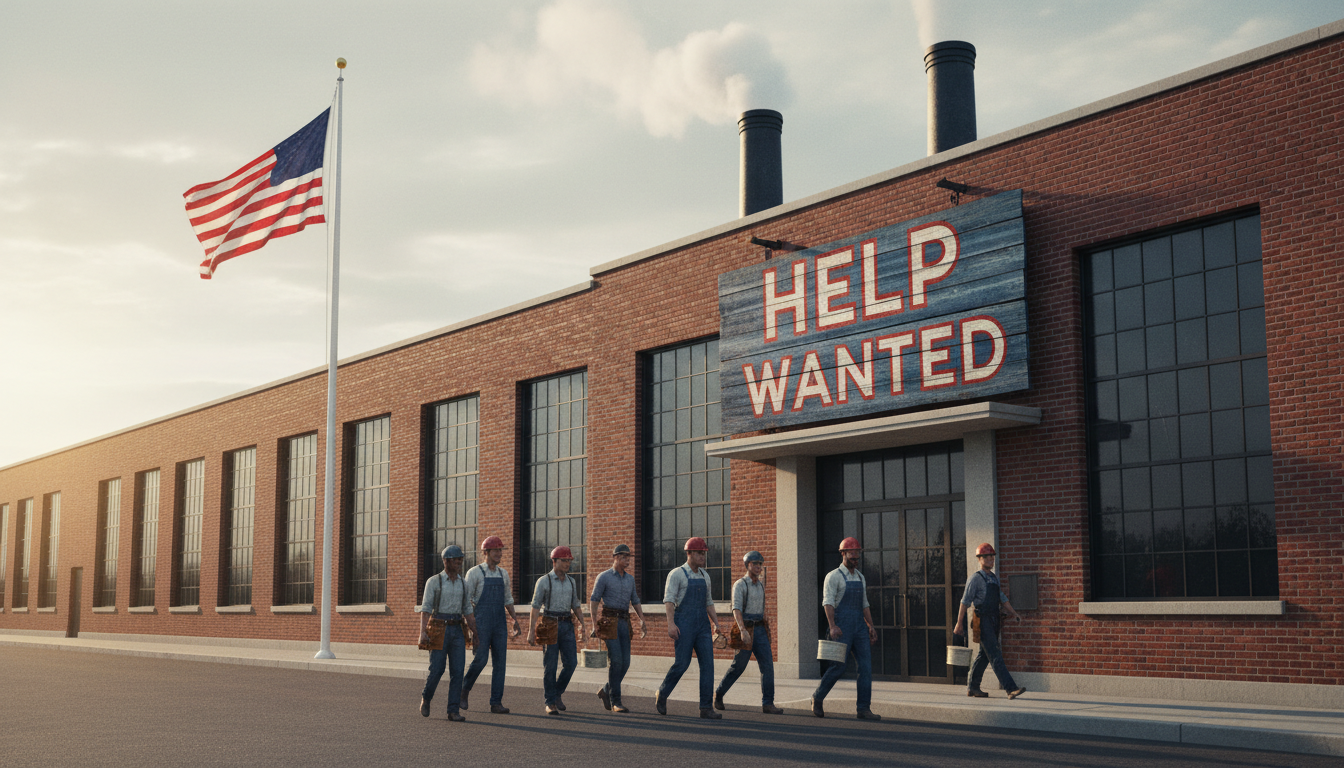
The April JOLTS report landed like a thunderclap: 7.618 million job openings, the highest in nearly two years and a full 731,000 above March’s reading. Economists had penciled in 6.8 million — they were off by nearly a million. Yet in the same month, actual hiring fell by 419,000, the quits rate dropped to its lowest since August 2020, and 4.3% of the labor force remains unemployed. The Conference Board now estimates America needs 4.6 million additional workers every year just to keep the supply-demand balance from snapping. The math — 7.6 million openings against 5.1 million hires — tells you everything: the jobs are there. The workers are not.
State by State: Where the Shortage Bites Hardest
South Dakota holds the most punishing ratio in America — just 46 available workers for every 100 open jobs, according to the U.S. Chamber’s Worker Shortage Index. With unemployment at 2.2% and a labor force participation rate of 68.3%, there is simply nobody left on the sidelines. The state’s 23,000 openings span agriculture, manufacturing, and hospitality — three sectors that compete for the same thin pool of workers.
Vermont sits at 0.53 on the same index, with just 9,019 unemployed workers chasing 17,000 openings. The state’s precision manufacturing and medical-device sector — highly specialized, heavily dependent on an aging workforce — faces a particularly acute replacement crisis. MIE Solutions flags Vermont’s manufacturing job-posting intensity at 0.97 per 1,000 BLS employees, third-highest in the country. Education and health services, the state’s largest employer, can’t escape the squeeze either.
Georgia posted 296,000 openings against 192,721 unemployed workers — a 0.65 shortage index that places it among the five tightest labor markets nationally. Trade, transportation, and utilities form the state’s employment backbone and its biggest pain point — these are physically demanding, often shift-based roles that have struggled to attract workers since the pandemic. The American Association of Colleges of Nursing projects Georgia faces a 21% nursing shortage by 2035, one of the worst in the country.
Virginia carries the highest manufacturing job-posting intensity in America at 2.83 — nearly three postings for every thousand manufacturing workers. Defense contractors, advanced materials firms, and federal supply chains all compete for machinists, maintenance technicians, and engineers from a workforce of just 237,200. The state’s 216,000 total openings against 163,222 unemployed workers means the pressure extends well beyond the factory floor — professional and business services, the state’s top employer, added tens of thousands of postings in April.
Alabama reports a 0.61 shortage index — 64,150 unemployed workers for 106,000 openings — but the headline figure understates the problem. The state’s labor force participation rate is just 57.7%, one of the lowest in the nation. That means a huge portion of the working-age population isn’t even looking. Construction and manufacturing dominate the state’s unfilled roles, and with the Associated Builders and Contractors estimating a 349,000-worker national shortfall in 2026, Alabama contractors are bidding against the rest of the country for the same carpenters and electricians.
Michigan has 545,000 professional-trades jobs to fill through 2026, according to the state’s Department of Labor and Economic Opportunity. The nursing shortage projection — 15% by 2035 — compounds the skilled-trades deficit in a state where manufacturing employment remains 463,200 strong and the job-posting intensity index sits at 0.65. Wisconsin, at 0.65 intensity and a 0.75 shortage index, mirrors Michigan’s pattern: plenty of demand, vanishing supply.
The Industry Breakdown
- Construction: 349,000 net new workers needed in 2026, per the Associated Builders and Contractors. For every five retirees, only two replacements enter the trades. Electricians are the scarcest trade — 20% are over 55, and the data-center boom is consuming every available one. The 2027 forecast jumps to 456,000 new workers needed.
- Manufacturing: The Conference Board projects up to 2.1 million unfilled manufacturing jobs by 2030. MIE Solutions’s job-posting intensity data shows the fight for talent has escaped the Rust Belt — Virginia, Montana, Vermont, and New Hampshire now lead the nation in hiring pressure per capita. Automation and reshoring are increasing demand faster than training pipelines can fill.
- Healthcare: HRSA projects a 140,000-physician shortage across 30 of 35 specialties by 2038, plus 108,000 missing nurses. Twenty-five states and D.C. are suing the Department of Education over new graduate-loan caps that could choke the pipeline. Washington state faces the worst nursing gap at 26%, followed by Georgia at 21% and California at 18%.
- Agriculture: The H-2A seasonal visa program is being expanded, but processing backlogs and political uncertainty are leaving crops unharvested. Farm labor shortages hit states like California, Florida, and Washington hardest — places where the Chamber’s shortage index has been worsening month over month.
- Hospitality and Food Service: Immigrants fill at least 20% of jobs in this sector nationally, and far more in states like Texas, Florida, and Nevada. As border encounters dropped precipitously in 2025 and voluntary deportations accelerated, the worker pipeline narrowed at exactly the moment consumer spending on dining and travel rebounded.
The Immigration Factor
Immigrants now account for 29% of the construction workforce and at least 20% of jobs in professional services, transportation, hospitality, manufacturing, and agriculture. From 2020 to 2024, immigration was 83% of net U.S. population growth — twenty states would have lost population without it. The Conference Board warns that deporting one million unauthorized workers per year for four years would push the labor force into net shrinkage by 2027, with agriculture, building maintenance, construction, and food service taking the hardest hits.
The H-2B visa cap for early-2026 start dates was reached by March 10. Associated Builders and Contractors is calling for a market-based worker visa system. The National Association of Home Builders says even the increased H-2B allocations are insufficient. Meanwhile, nearly half of international students in the U.S. are in STEM programs, and foreign students earn the majority of advanced degrees in economics (62%), computer science (59%), and engineering (58%) — talent that frequently leaves the country after graduation because there is no streamlined path to stay.
The Hiring Disconnect
Here is the paradox at the center of the 2026 labor market: job openings are surging toward multi-year highs while hiring is falling. The 7.6 million April vacancies represent a 731,000 jump from March, but companies hired only 5.12 million workers — down 419,000. The quits rate, a reliable proxy for worker confidence, dropped to just under 3 million, the lowest since the pandemic summer of 2020. Layoffs barely budged at 1.7 million.
Professional and business services added 668,000 openings — a category where AI adoption is beginning to reshape demand. Matthew Martin, senior U.S. economist at Oxford Economics, captured the mood precisely: “Neither employees nor employers are in a hurry to make moves.” The Iran conflict, energy-price volatility, and tariff uncertainty have frozen the usual labor-market churn. Employers are posting jobs but not filling them. Workers are staying put. The result is a low-hire, low-fire environment that looks stable on the surface and increasingly brittle underneath.
What to Watch
- May JOLTS — June 30, 2026: The next read on job openings, hires, and quits lands this week. After April’s surge, all eyes are on whether the openings number retreats or the hiring freeze continues.
- Construction workforce forecast: ABC’s 2027 projection of 456,000 new workers needed will test whether the industry’s apprenticeship push and visa-reform advocacy are moving the needle.
- H-2B visa expansion: DHS and DOL have authority to add up to 22,000 supplemental visas for FY2026. A decision — and its political fallout — is expected in the coming weeks.
- Graduate loan cap lawsuit: Twenty-five states and D.C. are challenging Education Department caps on graduate-student borrowing. If the caps hold, medical, nursing, and allied-health programs could lose the students they desperately need.
- Data-center labor demand: Electrician demand is surging as AI infrastructure buildout accelerates. Watch for wage spikes in northern Virginia, Phoenix, and Dallas — the data-center capitals where construction labor was already stretched thin.
- Manufacturing wage inflation: Virginia, Montana, and Vermont are the canaries — if manufacturers in high-intensity states start reporting wage-driven margin compression in Q2 earnings calls, the labor shortage will have officially hit the bottom line.
Sources and Further Reading
Bureau of Labor Statistics — JOLTS April 2026 and Employment Situation May 2026; U.S. Chamber of Commerce — Worker Shortage Index (December 2025); Associated Builders and Contractors — 2026 Workforce Shortage Analysis (January 2026); The Conference Board — Responding to US Labor Shortages (June 2025); JLL — Critical Skilled Trades Shortage Report (April 2026); MIE Solutions — U.S. Manufacturing Labor Shortages and Hiring Pressures in 2026; HRSA — Health Workforce Projections (2025); CNBC — Job Openings April 2026 (June 2, 2026); NPR — The Future of the American Healthcare Workforce (May 26, 2026).