

Welcome back to the monthly Trading Partner Inflation Check. Each month, we track CPI across the nine largest U.S. trading partners to see whether American goods are getting more or less competitive on price — and what that means for everything from the Fed’s next move to your grocery bill.
Last month’s story was broad disinflation: six of nine countries saw rates decline, and the nine-country average dipped to 2.9%. This month, that trend has reversed sharply. Seven of nine partners saw inflation accelerate in August. The two that held flat — the United States and Canada — only look steady on the surface. The average across all nine trading partners ticked up to 2.9%.
The Big Picture
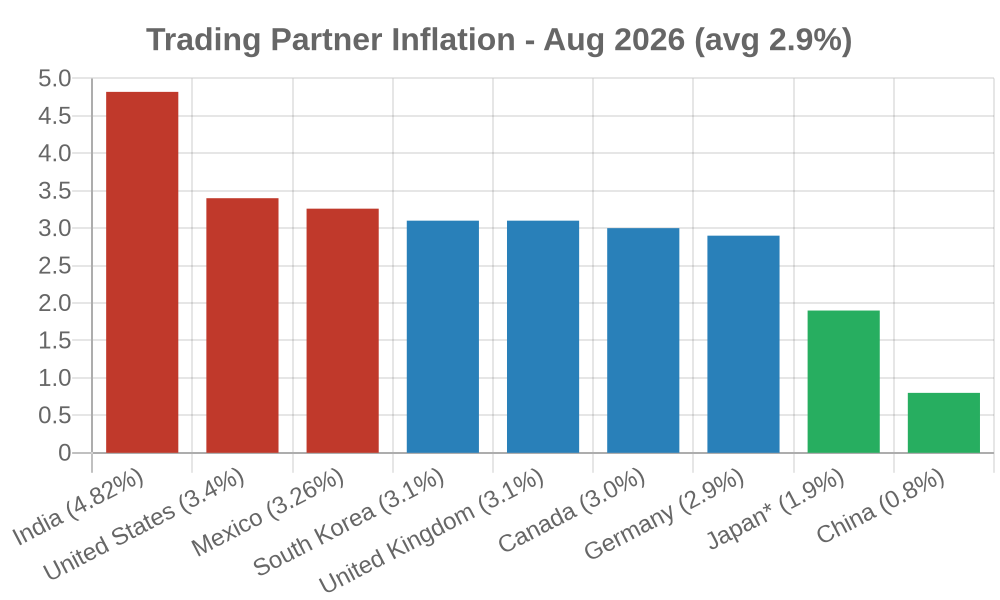
At 2.9%, the nine-country average masks enormous divergence. India leads the pack at 4.82% — the highest reading among all partners and nearly a full percentage point above the US. At the opposite end, China’s 0.8% inflation rate remains barely above deflation despite a modest uptick from July’s 0.5%. The 4-percentage-point spread between India and China is the widest gap in this series since we started tracking.
The US, at 3.40%, sits right in the middle — but “unchanged” doesn’t mean healthy. Core CPI actually improved, dropping to 2.40%, while the headline held steady at 3.40% thanks to a 0.4% monthly jump driven partly by apparel.
The Standouts: Winners and Losers
The Accelerators
Six countries posted meaningful increases. India’s jump from 4.44% to 4.82% was the largest absolute move, driven by food prices. South Korea’s rise to 3.1% came with an asterisk: a one-off base effect from mobile-service discounts last year flattered the headline, and core inflation hit 3.4% — its fastest pace since May 2023. The Bank of Korea can’t dismiss this as noise.
The UK also moved higher to 3.1%, with services inflation stubbornly above 5%. Germany ticked up to 2.9% as energy base effects faded. Mexico’s 3.26% broke a five-month streak of declining inflation; food and services were the culprits. Even China’s 0.8% — still laughably low by global standards — represents the first meaningful uptick since the country’s stimulus efforts began.
Holding Steady (But Not Comfortably)
The US held at 3.40%, right on consensus. But drill down and it’s a mixed bag: core CPI fell to 2.40% (good), but the monthly headline rise of 0.4% was led by volatile categories like apparel. Shelter — the Fed’s white whale — remains stubborn. Canada also held flat at 3.0%, though gasoline inflation of 22.8% tells a story of its own. Excluding gas, Canadian CPI was just 2.4% — meaning energy is papering over otherwise benign readings.
Trade Competitiveness: The Inflation Calculus
Inflation differentials matter for trade because they directly affect relative prices. When your inflation runs hotter than your trading partners’, your exports become more expensive and imports get cheaper — all else equal. Here’s how the math works this month:
- The US (3.40%) has an inflation advantage over India (4.82%) and is roughly even with Mexico (3.26%), South Korea (3.10%), and the UK (3.10%). Against these partners, US goods aren’t losing competitiveness.
- But the real story is China at 0.8%. That’s a 2.6-percentage-point disadvantage for American exporters — the widest gap since we began tracking. Every month that China runs near-zero inflation while the US runs above 3%, Chinese goods gain a price advantage.
- Germany (2.9%), Canada (3.0%), and Japan (1.9%) offer modest inflation advantages to the US — nothing dramatic, but persistent. Over 12 months, a 1-point differential compounds.
- The dollar’s performance partially offsets the China gap. A strong dollar makes US exports more expensive regardless of relative inflation rates. August saw continued dollar strength against most Asian currencies.
Fed Implications
The Fed meets this week, and the trading partner data lands at an awkward moment. The headline US inflation rate of 3.40% remains well above the 2% target, but core CPI at 2.40% shows genuine progress on the stickiest components. The global reacceleration we’re seeing across seven of nine partners suggests that the easy disinflation gains — falling energy prices, healing supply chains — are largely behind us.
The risk: if inflation is reaccelerating broadly across the global economy, the Fed’s path to 2% gets harder, not easier. Markets are pricing in a hold at this week’s meeting, but the trading partner data argues for caution on rate cuts through year-end. The Bank of Korea’s 3.1% (with core at 3.4%) is a cautionary tale about declaring victory too early.
The Bottom Line
After a few months of broad disinflation, August delivered a wake-up call: inflation isn’t done yet. Seven of nine US trading partners saw rates accelerate, and the two that held steady did so on shaky foundations. For American importers, the China differential remains the dominant competitive force — Chinese goods just keep getting cheaper in relative terms. For the Fed, the global reacceleration makes the last mile of the inflation fight look longer and steeper than it did a month ago.
The Trading Partner Inflation Check publishes monthly on the 16th. Next edition: October 16, 2026. Data sources: BLS (US), INEGI (Mexico), Statistics Canada, NBS (China), Statistics Bureau of Japan, Destatis (Germany), KOSTAT (South Korea), ONS (UK), MOSPI (India). *Japan national CPI for August releases September 17, 2026.