

Welcome back to the monthly Trading Partner Inflation Check. Every month we track consumer price inflation across America’s nine largest trading partners — because what happens to prices in Mexico City, Tokyo, and New Delhi doesn’t stay there. It shows up in your import bills, your supply chain costs, and eventually your own cost of living.
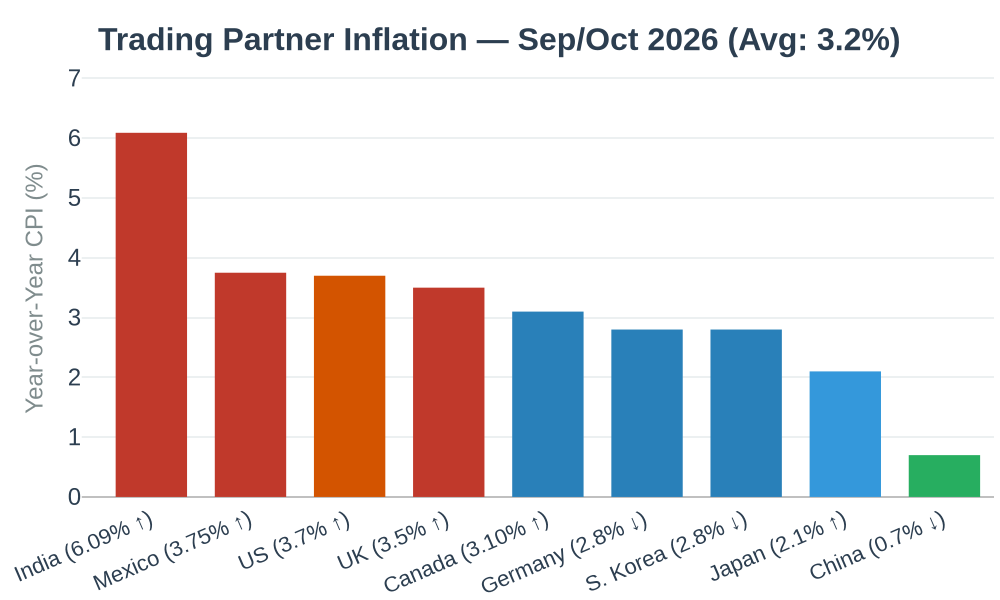
This month’s data spans September and October 2026, and the headline is a reversal: after months of broad disinflationion, inflation is re-accelerating across our trading partners. Six of nine countries saw their inflation rates rise. The average across all nine partners now sits at 3.2%, up from 2.9% in our last check.
The Big Picture
The 9-country average ticked up to 3.2% — a meaningful jump from the 2.9% we reported in July/August. Back then, six of nine countries were seeing inflation decline. Today, that ratio has completely flipped: six of nine are rising. The broad disinflationion wave that characterized the first half of 2026 appears to be losing steam.
Three forces are driving the reversal. First, energy prices — crude oil has been climbing since mid-summer, and that shows up in every country’s CPI through higher gasoline, diesel, and heating costs. Second, food prices are surging globally, with India’s 6.09% headline heavily driven by food inflation at 6.63% in rural areas. Third, services inflation remains stubborn almost everywhere — haircuts, rent, insurance, and healthcare don’t deflate easily.
The Standouts: Winners and Losers
At the top of the pack, India at 6.09% has broken through the Reserve Bank of India’s 6% upper tolerance band for the first time under Governor Malhotra. Food and fuel drove the surge, with rural inflation running at a punishing 6.63%. The RBI now faces an uncomfortable choice: raise rates into a slowing economy or let inflation run hot. Markets are pricing in a 25-basis-point hike at the December meeting.
Mexico (3.75%) has now risen for three straight months — up from 3.12% in July. The peso’s modest depreciation against the dollar is feeding through to import prices, and non-core inflation (fresh food and energy) jumped 1.2% month-over-month in October. For US companies with nearshored manufacturing in Mexico, input costs are trending up after a long period of stability.
The United States (3.7% in September) sits uncomfortably above the partner average. October’s official year-over-year figure is unavailable — BLS couldn’t collect data in October 2025 due to a congressional appropriations lapse — but the 0.4% monthly increase in October CPI suggests inflation momentum isn’t fading. The 10-year Treasury yield retaking 5% tells you markets agree.
The UK (3.5%) hit its highest level since October 2025, driven by energy base effects and a tight labor market. The Bank of England held rates at 3.75% in November but the inflation uptick complicates any near-term easing plans.
Canada (3.10%) continues its slow creep upward from 2.5% in June. Gasoline and diesel are the primary culprits, though shelter costs remain elevated. The Bank of Canada’s October Monetary Policy Report warned inflation could stay around 3% “through much of 2027” — not what anyone wants to hear heading into winter.
The Disinflation Outliers
Not everyone is feeling the heat. Germany (2.8%) delivered the biggest positive surprise, dropping half a percentage point from September’s 3.3%. Energy price normalization and a softening economy are doing the heavy lifting. Destatis President Ruth Brand noted inflation is “just under three percent again” — a welcome reprieve for Europe’s largest economy and a data point that strengthens the ECB’s case for an early 2027 rate cut.
South Korea (2.8%) eased for a second straight month, down from 2.9% in September and 3.0% in August. The Bank of Korea’s early and aggressive hiking cycle appears to be paying dividends, though household debt levels remain a structural concern.
At the bottom, China’s 0.7% CPI reading isn’t just low — it’s practically deflationary once you strip out food. Producer prices, meanwhile, surged at 5.7% year-over-year, their fastest clip in nearly four and a half years. This producer-consumer price wedge means Chinese manufacturers are absorbing higher input costs without passing them to consumers — a competitiveness subsidy that hurts their margins but keeps Chinese exports cheap on global markets.
Trade Competitiveness: The Inflation Calculus
Inflation differentials are a silent tax on trade competitiveness. When US inflation runs at 3.7% and China’s at 0.7%, the real exchange rate shifts by 3 percentage points per year against American exporters — even if nominal exchange rates don’t move. Over a two-year period, that’s a 6% competitiveness erosion.
The most acute pressure point is Mexico. US nearshoring investments have surged since 2022, but Mexico’s accelerating inflation (3.75% and rising) means US companies are paying more in dollar terms for Mexican-produced inputs. Combined with US domestic inflation at 3.7%, the “nearshoring discount” is shrinking.
India’s 6.09% creates a different problem. For US tech companies with large Indian workforces and back-office operations, rupee depreciation partially offsets inflation, but wage pressures in India’s urban centers are building. The IT services cost advantage that American companies have relied on for two decades is being slowly eroded by domestic Indian inflation.
The dollar provides a partial buffer. The DXY has strengthened roughly 4% since September, which cushions US importers against partner-country price increases. But a strong dollar cuts both ways — it makes US exports less competitive at exactly the moment partner inflation is making US goods more expensive in real terms.
Fed Implications
The global inflation reacceleration lands at an awkward moment for the Federal Reserve. October’s domestic CPI was already running hot — the November 10 release showed a 0.4% monthly increase — and now six of nine major trading partners are seeing their own inflation tick up. This is not the supportive external environment the Fed was hoping for.
The bond market is voting with its feet: the 10-year Treasury yield retook 5% last week, and the 2-year/10-year spread has steepened in a way that historically signals markets expect the hiking cycle to extend. Governor Waller’s recent comments about a “supersized December hike” suggest the FOMC’s internal debate has shifted from “when to pause” to “how much more is needed.”
Meanwhile, the global rate cycle is diverging. The ECB may have room to cut in early 2027 if Germany’s disinflationion holds. The BOJ hiked in October and Japan’s 2.1% inflation above target supports further normalization. The RBI is backed into a corner. This divergence — ECB cutting while the Fed hikes — would strengthen the dollar further, tightening US financial conditions even without additional Fed action.
The Bottom Line
The global disinflationion narrative that dominated the first half of 2026 has cracked. Six of nine major US trading partners are now seeing inflation reaccelerate, the average rate has climbed to 3.2%, and India has broken through its central bank’s ceiling. For US businesses and consumers, the implications are straightforward: import prices are heading up, the Fed is staying hawkish, and the competitive buffer from low partner-country inflation is shrinking. The 10-year at 5% isn’t an anomaly — it’s the bond market pricing in a world where the inflation fight isn’t over.
The next Trading Partner Inflation Check publishes December 16, 2026, covering November CPI data across all nine partner countries.